skm-tools: analysing PSS and CKN in Python
Overview
skm-tools is a Python package for questions about PSS and CKN that go beyond what the PSS and CKN Explorers offer. It loads the networks from the SKM downloads into networkX, so that all of networkX's graph analyses can be used, and adds functions for the typical steps of an SKM analysis: filtering the networks, neighbourhoods, shortest paths, subnetworks, adding experimental data, translating CKN to other species, and showing the results in Cytoscape or DiNAR.
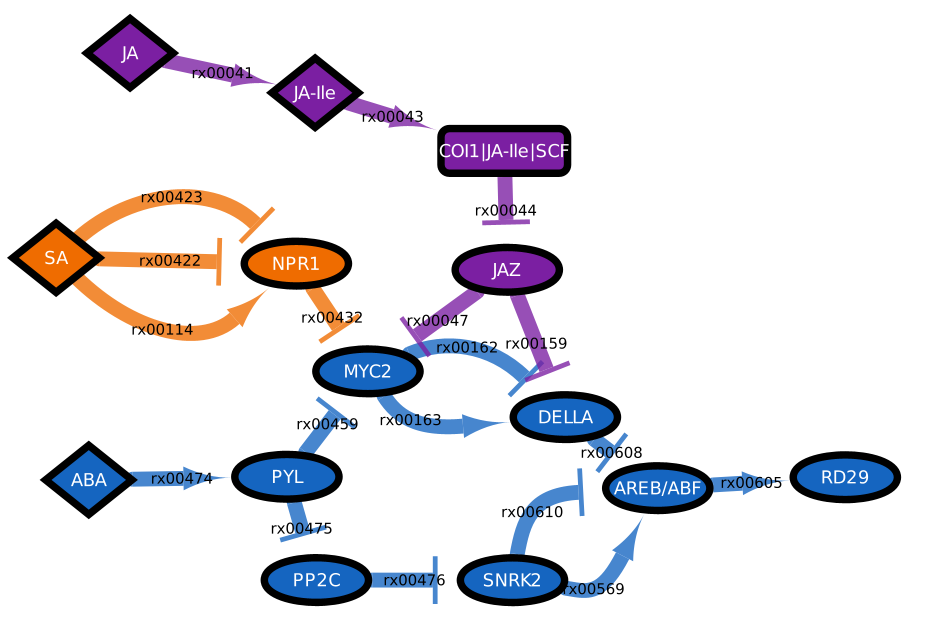
Example: the shortest paths from ABA to RD29 in PSS, and where SA and JA reach them, shown in Cytoscape with skm-tools.
Install and start
pip install "skm-tools @ git+https://github.com/NIB-SI/skm-tools.git"from skm_tools.pss import pss_interaction_network_to_networkx
pss = pss_interaction_network_to_networkx(data_dir="data") # downloads the public PSS on first useOptional extras (e.g. Cytoscape automation) and the other networks are described in the documentation.
Documentation
- skm-tools documentation: installation, the PSS and CKN networks, analyses, translations, Cytoscape and DiNAR, and the API reference
- Tutorials: PSS, CKN
- Releases and changes
The two case studies of the SKM publication (ABA, JA and SA in the activation of RD29, Ca2+-dependent peroxide responses in CKN) are kept as they were published, with the skm-tools and PSS/CKN versions of that time (the publication branch).